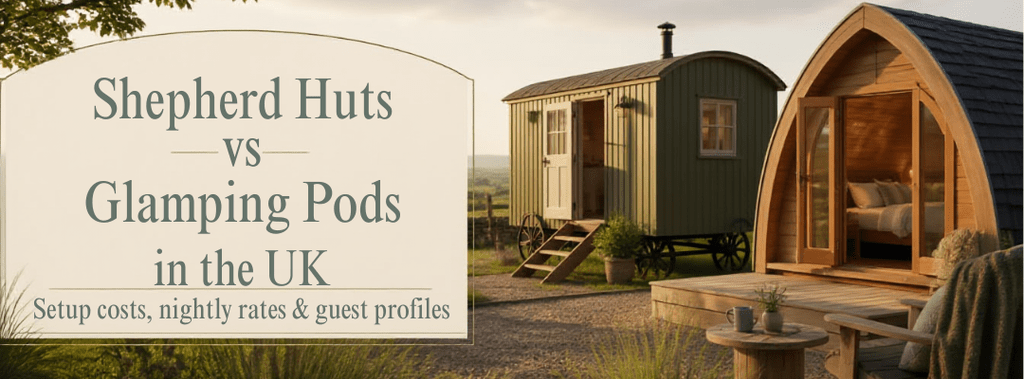
Shepherd’s Huts vs Glamping Pods in the UK: Which Is Better for a Holiday-Let Business?
For landowners, rural businesses, hospitality operators and prospective glamping-site owners, both shepherd’s huts and glamping pods can create attractive, low-footprint accommodation. The better choice depends on more than the purchase price: site character, planning constraints, target guests, specification and long-term operating plans all matter.
This guide compares the two formats across initial set-up costs, potential nightly rates, guest profiles, scalability and planning considerations. All figures are broad UK indications rather than guarantees; actual performance depends on location, season, views, privacy, facilities, specification and local competition.
The core difference: character versus efficiency
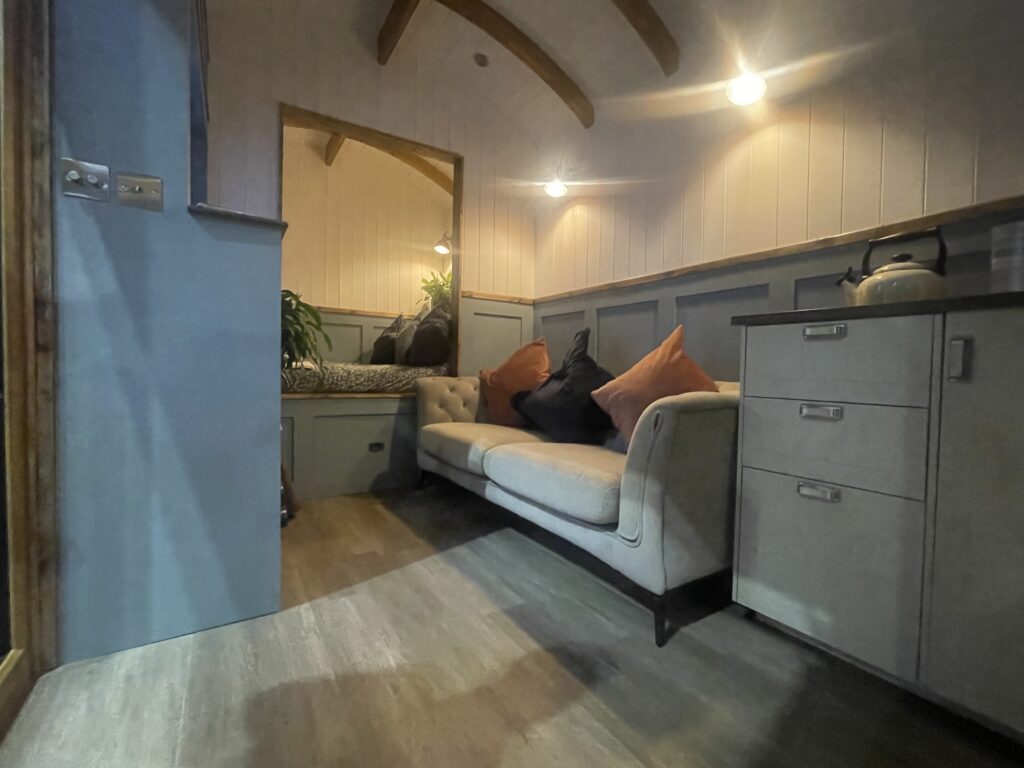
A shepherd’s hut is a character-led, traditionally styled accommodation unit, often built on a wheeled chassis. Modern huts commonly include a double bed, kitchenette, shower room, heating, wood burner and carefully designed interiors. Their appeal is rooted in craftsmanship, heritage and the feeling of staying somewhere distinctive.
A glamping pod is generally a contemporary, compact timber structure designed for efficient use of space, insulation and repeatable manufacture. Pods range from simple sleeping cabins to fully equipped en-suite units, with layouts that can often be adapted for couples, families or multiple pitches.
At a glance
Shepherd’s huts tend to sell romance, heritage and individuality. Glamping pods usually offer efficient, scalable and all-weather accommodation.
Initial set-up costs
The unit itself is an important starting point, but it should not be treated as the full investment. Indicative supplier pricing suggests that shepherd’s huts generally require a higher initial outlay when specified as complete holiday accommodation, while pods can offer a lower entry point.
| Accommodation type | Indicative starting or completed-unit cost | What may affect the price |
| Entry-level shepherd’s hut | Approximately £18,000–£25,000 | Usually before a full luxury fit-out, delivery and site works |
| Holiday-let-ready shepherd’s hut | Approximately £37,500–£48,000 plus VAT | Bathroom, kitchenette, bed, heating, size, materials and specification |
| Basic glamping pod | From approximately £13,500 plus VAT | Internal fit-out, insulation, services and delivery |
| Installed turnkey en-suite pod | Approximately £24,500 plus VAT | Bathroom specification, upgraded services, access and installation requirements |
Costs beyond the accommodation unit
Both formats may require a substantial range of supporting works and guest amenities:
- Site works — ground preparation, access, landscaping, decking and suitable hard standings.
- Services — water, drainage, electricity, Wi-Fi, lighting and waste arrangements.
- Guest facilities — hot tubs, fire pits, outdoor furniture, appliances, linen and welcome amenities.
- Professional requirements — planning, surveys, professional fees, insurance and compliance work.
A lower-cost pod is not automatically the cheaper completed project. Extensive drainage, a new access track, difficult ground conditions or long service connections can quickly increase the total cost. Ask for a realistic site-wide budget before comparing unit prices alone.
Potential nightly rental rates
Nightly pricing varies enormously across the UK. A simple unit in a less tourism-led location will perform differently from a secluded, design-led stay with a private hot tub, strong views and easy access to a national park, coast or major city. Specification, privacy, seasonality, photography, reviews and local competition will all influence the achievable rate.
| Accommodation type | Typical UK indication* | Higher-end examples |
| Basic glamping pod | £80–£130 per night | £140–£180+ |
| En-suite glamping pod | £110–£170 per night | £180–£250+ |
| Well-finished shepherd’s hut | £120–£190 per night | £200–£300+ |
*Important: These are broad, indicative UK ranges, not guaranteed income. Operators should benchmark comparable listings within a realistic local drive-time radius, then test pricing by season and by level of finish.
Shepherd’s huts often have stronger premium and special-occasion appeal. Anniversaries, mini-moons, proposal weekends, birthdays, cosy winter breaks and design-led rural escapes can support an experience-led price position. Their compact size is less of a disadvantage when the product is sold around atmosphere, privacy and memorable details.
Pods can achieve comparable premium rates when they offer standout design, attractive views, privacy or valuable amenities. Without those differentiators, however, a pod may compete more directly with similar local accommodation, making specification and marketing especially important.
Typical guest profiles
The wider glamping market is led principally by urban, relatively affluent couples aged roughly 25–44. Canopy & Stars market-report observations indicate that 25–34 is often the largest age group, around 60% of bookings are made by women, dog-friendly breaks account for roughly 18% of bookings, and bookings with children are around 13%. These figures are useful market indications, not universal rules for every site.
What this means for an operator
The unit should match the audience you can realistically attract. Consider whether your site is best suited to romantic privacy, accessible family accommodation, dog-friendly outdoor breaks, or several flexible units for groups.
Who is most likely to book a shepherd’s hut?
Shepherd’s huts are particularly well suited to:
- Romantic couples seeking a rural break with a strong sense of escape.
- Special-occasion guests booking anniversaries, birthdays, proposals and mini-moons.
- Design-conscious travellers who value craftsmanship, bespoke interiors and visual character.
- Cosy, year-round visitors attracted by wood burners, baths, warm materials and thoughtful styling.
- Short-break customers looking for a distinctive alternative to a conventional hotel.
They tend to work best where the site can deliver privacy, character and a clear sense of place.
Who is most likely to book a glamping pod?
- Glamping pods commonly appeal to:Budget-aware couples and weekend visitors who want comfort without the price of a cottage.
- Families where larger pods or multi-pod layouts are available.
- Dog owners, walkers and cyclists looking for practical, activity-led accommodation.
- Groups booking several units together for a shared trip.
Pods can therefore support a broader mix of guests, particularly when an operator wants repeatable accommodation across several pitches.
Operations and scalability
A shepherd’s hut can be the stronger single-unit flagship. It can be photographed beautifully, marketed as a unique stay and priced around the overall experience rather than floor area. That distinctiveness can help a boutique site stand out, but bespoke finishes and traditional construction may increase capital cost, maintenance complexity and lead time.
Pods are often better suited to scaling a site. Their more standardised form can make them easier to procure, install and maintain consistently across multiple pitches. They can support a small village of accommodation, shared facilities, or a planned mix of two-berth and four-berth units.
The operational choice is not only about how many units you want today. Consider how much variation your housekeeping team can manage, how replacement parts will be sourced, whether every unit needs the same cleaning checklist, and how easily a new pitch could be added later.
Questions to answer before committing
- Will one distinctive unit create a stronger brand than several similar units?
- Can the site support reliable access for delivery, servicing, waste collection and emergency vehicles?
- Will your team be able to maintain bathrooms, heating systems, hot tubs and outdoor areas throughout the year?
- Does the layout allow future expansion without compromising privacy, views or the guest experience?
Planning and site considerations
Being on wheels does not automatically remove the need for planning permission. In England, a shepherd’s hut or pod may be treated as a caravan if it meets the relevant definition, but that is only one part of the planning picture.
Commercial glamping use, permanent siting, hard standings, drainage, lighting, access tracks and utility works can all trigger planning requirements. A proposal may also involve a change from agricultural or woodland use, which should be considered before ordering a unit or beginning site works.
Limited permitted-development rights may apply in some circumstances, including up to 60 days per calendar year for qualifying temporary recreational campsites. A full commercial operation, permanent installation or change of land use will commonly need formal planning consent. Rules and interpretations can vary, so check with the relevant local planning authority and take professional advice.
Other obligations to check
- Business rates and the appropriate treatment of the accommodation business.
- Safety requirements covering fire safety, gas installations and electrical systems.
- Insurance that reflects commercial short-term letting, guests, buildings and site activities.
- EPC obligations and any other energy or building requirements that apply to the proposed accommodation.
In England, a mandatory registration scheme for short-term lets is expected to begin in 2026. The Furnished Holiday Let tax regime was abolished on 6 April 2025. Regulations can change, so confirm the current position with the Government, your local authority and suitably qualified advisers before investing.
Shepherd’s hut vs glamping pod: at-a-glance comparison
| Factor | Shepherd’s hut | Glamping pod |
| Initial unit cost | Usually higher, especially with a complete luxury fit-out | Usually lower at entry level, though services can narrow the gap |
| Character | Heritage-led, handcrafted and highly distinctive | Modern, practical and adaptable |
| Premium-rate potential | Strong for romantic and special-occasion stays | Strong with standout design, views, privacy or amenities |
| Best guest market | Couples, special occasions and design-conscious travellers | Couples, families, dog owners and activity-led visitors |
| Scalability | Best suited to boutique sites or a premium flagship | Well suited to multiple pitches and standardised expansion |
| Year-round appeal | Excellent with insulation, heating and a wood burner | Excellent when fully insulated and en-suite |
| Brand positioning | Boutique, luxurious, memorable and experience-led | Accessible, contemporary, flexible and efficient |
Conclusion: which is better for your business?
Choose a shepherd’s hut when the aim is a high-character, high-value stay for couples, with design, privacy and emotional appeal at the centre of the offer. It is particularly effective as a premium standalone unit or as part of a small collection of distinctive retreats.
Choose a glamping pod when the priority is lower entry cost, efficient deployment and the ability to scale. Pods can suit a wider mix of couples, families, dog owners and outdoor travellers, especially when several units are planned for one site.
For many UK operators, the strongest model may be a mixed site: shepherd’s huts can act as premium hero accommodation while pods provide accessible, flexible inventory. The right mix should follow the site’s planning position, landscape, access, services and target market rather than a generic industry formula.
Practical takeaway
Before choosing a unit, create a site-wide budget, benchmark comparable local listings, define your target guest and speak to the local planning authority. The best format is the one that your land, permissions, operations and guest proposition can support consistently.